Thursday, 17 November 2011
Photoshop Progression 2
Although I still have not completed my first final image I wanted to make a start on the second. After studying sunsets I wanted one with warm and cold colour values.
Wednesday, 16 November 2011
Avatar (2009) Review
James Cameron's Avatar is a science fiction film of epic proportion. The truly awe-inspiring production design and setting of the film more than compensates for shaky plot and almost 'knew that was going to happen' scenes. In fact the 3D and digital world that was created for Avatar was so spectacular even the worst plot and dialogue would still become secondary to those who can appreciate the work and dedication that went into making Avatar something visually astounding.
One could base the premise on this film that it is almost Anti American and relates to the Afghanistan War. "To this fusion of science fiction and environmental parable Cameron adds a contemporary spin by lacing his script with War On Terror allusions." (Sandhu:2009) People have speculated that the Afghanistan War did not occur merely as the means to remove the Taliban regime but to financially benefit the Americans by obtaining minerals from crude oil rich Afghanistan. Whether this notion has any backbone is arguable but the way in which the marines are perceived in Avatar demonstrates America as an all powerful country whom take resources from other lands with a disregard for the natives.
The essentially dull plot of marine Jake Sulley (Sam Worthington) falling in love with the native Avatar, Neytiri (Zoe Saldana) is merely a modern day Pocahontas. It appears in the movie world, originality can often be lacking. Consider Jake Sulley's journey of self discovery, whereby the soldier finds himself falling in love with the civilisation he should be fighting against leading him to switch sides. This plot is awfully resonant of 'The Last Samurai' which itself unoriginally followed the same plot as 'Dances with Wolves'. Avatar sets itself apart from these however by the sheer scale of the film and groundbreaking CGI "Its both wildly original and hauntingly familiar."(Pond:2010) Although the sentiment is there, the morality of the film is almost shoved down the audience's throat and at times the predictability of Avatar mars the moral message it is trying to convey.
Aside from the plot, visually the film is flawless. The imagination that went into this film is truly inspiring and the scenery is breathtaking throughout the entire 162 minutes. From Pandora's jungle to the floating Hallelujah Mountains, everything is larger than life. The exaggerated colours of the plants, glowing in pinks and greens almost make the film appealing in the same manner as a fireworks display. The stunning scenes draw the viewer into this world that seems so real. So real in fact there is almost a sense of disappointment when following the film, with the realisation that people are not blue and 12ft tall. "The digitally created world meshes pretty much seamlessly with ordinary reality in an undoubtedly impressive way." (Bradshaw:2009)
List of Illustrations
Fig 1. Jake Sulley's Avatar
Fig 2. Neytiri
Fig 3. Sulley and Neytiri in the Pandora Jungle
http://www.allmoviephoto.com/photo/2009_Avatar_photo.html
Bibliography
Sandhu. S of The Daily Telegraph (published 17 December 2009) http://www.telegraph.co.uk/culture/film/filmreviews/6832593/Avatar-full-review.html (accessed on 16 November 2011)
Pond. N of American Profile (published January 19 2010) http://www.wilsoncountynews.com/article.php?id=25758&n=movie-reviews-blue-beautiful-avatar-will-blow-you-away (accessed on 16 November 2011)
Bradshaw. P of The Guardian (published 17 December 2009) http://www.guardian.co.uk/film/2009/dec/17/avatar-james-cameron-film-review (accessed on 16 November 2011)
Edward Scissorhands (1990) Film Review
Edward Scissorhands poster art
Edward Scissorhands is perhaps the film that has defined the career of director Tim Burton as well as acting as the catalyst that shot Johnny Depp into the stratosphere as a mainstream actor and household name. With the rise of films rife with violence, sex and one dimensional action heroes that plagued cinemas in the early 90's Edward Scissorhands was a breath of fresh air for movie goers. Although the movie essentially follows the classic Belle et la Béte fairy tale plot in which an outsider falls in love with the stereotypical beautiful female lead, the production and character design make Edward Scissorhands completely unique and an absolute joy to watch.
Edward played by rising star Johnny Depp is a synthetic human, created by an old and eccentric inventor (Vincent Price). Dwelling in the mysterious but strangely beautiful European gothic castle, the old inventor creates a man to alleviate his loneliness, Edward whom remains incomplete at the time of the inventors death leaving him a prisoner in his own body as well as a prisoner in the dilapidated castle. The hands are the tools used to feel, to express, to hold a loved one. Without this dexterity the world can be a lonely place which is made apparent by Edward's predicament, having large intimidating blades for hands. He is discovered some years later by Peg Boggs (Diane Wiest) an avon caller whom takes pity on the man with scissors for hands, taking him to live in the quaint suburban town she calls home. With no previous interaction with human beings Edward has a child like innocence which contrasts with his rough exterior."Edward stands apart from Tim Burtons other films because Edward is the sweetest, most innocent soul." (Biodrowski:2000). In a town where appearance is everything and beauty really is skin deep the town soon turn against the artificial Edward, assembling a Frankenstein style lynch mob forcing him back into the haunt from which he came. "It ends up being a melancholy tale that critiques human nature and conformity." (Schwartz: 2008)
The German Expressionistic element of this film is apparent in the use of colour. The blackness of the castle along with its inhabitant Edward is taken from the 1920's classic 'The Cabinet of Dr Caligari'. Another comparison that could be made between these two films is the emphasis on everything being slanted and unsymmetrical in the castle from the arched windows to the crumbling attic. This arguably expresses peculiarity and disarray as the supposed perfect suburban town below is all completely symmetrical, block buildings that mirror each other. Depp also used an overly expressive style of acting to play the role of Edward similar to that of a silent film where there was no dialogue as a means to express the character. "He gives a silent-movie performance, relying on his movements to communicate everything that is needed." (Larsen:2008). This is perhaps due to Edward only uttering a few words throughout the film and his apparent awkward interaction with other people..
The use of pastel colours in the town could possibly represent consumer marketing in America whereby all the interior flaws are masked by exterior beauty. There are many skeletons in many closets among the locals which are all masked by bright colours and civilised gatherings. From the adulterous vixen neighbour to the abusive boyfriend of Kim (Wynona Ryder) the audience find that the synthetic Edward is infact more human than the town's folk and clearly made a spectacle as a means of cheap entertainment and to benefit the town's own existence. During the final climactic scene, Kim chases after Edward into the castle wearing a white dress similar to that of a bride at a wedding. They both embrace, standing close to each other in the attic of the gothic castle at the top of the hill which over looks all, the summit of this fairytale world. This could arguably represent a bride and groom atop a wedding cake.
Although some would argue that the novelty has worn off with the recurring gothic fairy tale theme of Tim Burton's work, Edward Scissorhands is arguably one of the most imaginative, unique and thought provoking films of the 90's and will still be enjoyed by children and adults alike for many years to come.
Bibliography
Biodrowski. S of Cinefantastique (Published October 24 2000) http://cinefantastiqueonline.com/2000/10/edward-scissorhands-tim-burtons-elephant-man/ (Accessed 16,11,11)
Schwartz. D of Ozuz World Movie Reviews (Published 3 July 2008) http://homepages.sover.net/~ozus/edwardscissorhands.htm (Accessed 16,11,11)
Larsen. J of Larsen on Film (July 25 2008) http://www.larsenonfilm.com/index.php?Search=Edward%20Scissorhands%20Winston&AllWords=on (Accessed on 16,11,11)
List of Illustrations
Fig 1. The Gothic castle
Fig 2. Edward the spectacle
Fig 3. The final goodbye
http://s23.photobucket.com/albums/b395/JohnnyDeppZone2/screencaps/cap%20edward%20scissorhands/?start=all
Tuesday, 15 November 2011
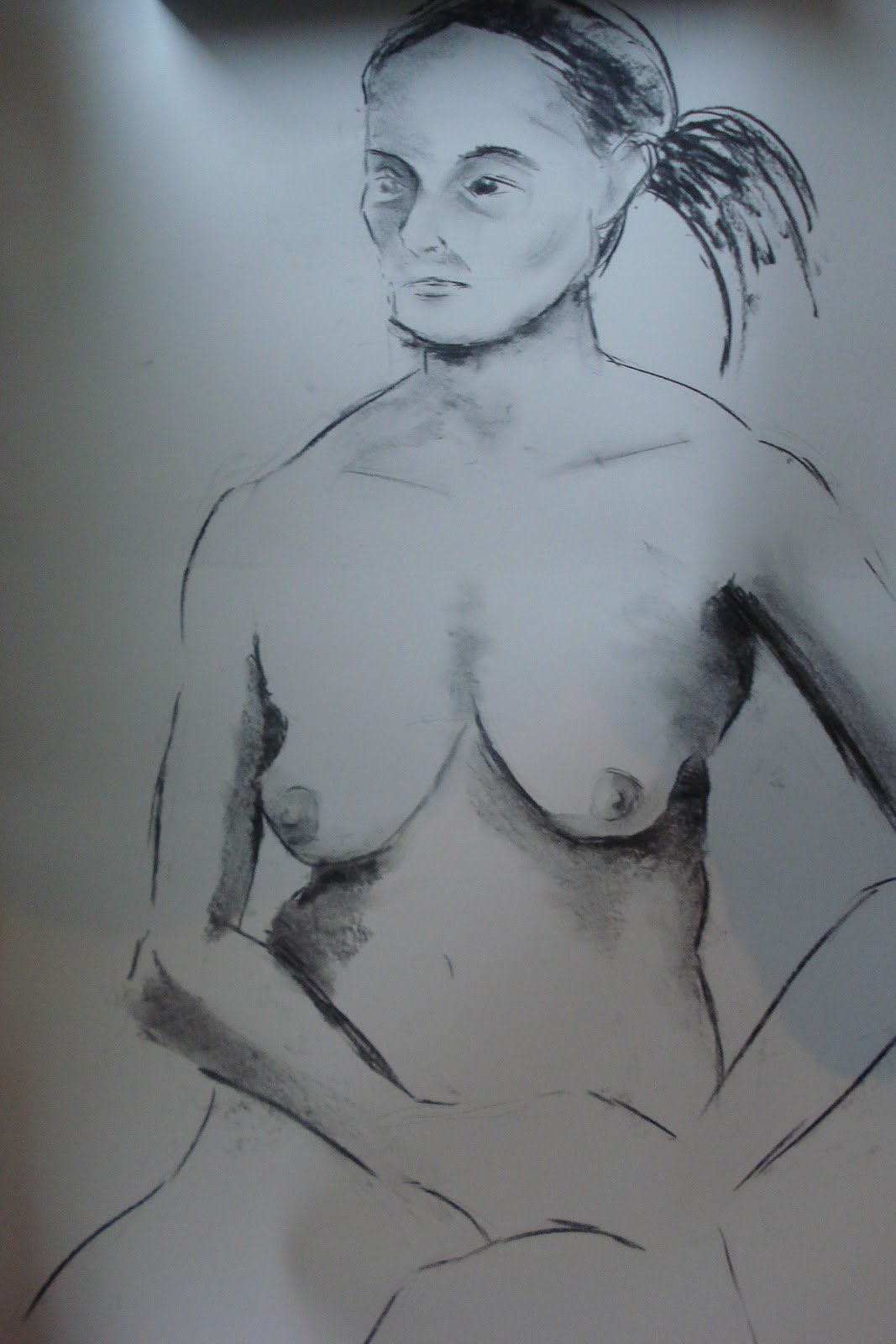
Life Drawing Week Nine
I particularly enjoyed this life study class as aside from the drawing warm up at the beginning we had the entire lesson to work on just one drawing. I chose to use green biro as I thought it would be interesting to experiment and see what the outcome was.
Saturday, 12 November 2011
Warm and Cold Colour Values
One basic principle Photoshop Phil taught us was how to incorporate warm and cold colours into a picture to make it pop and show the source of light. I am still tinkering around with ideas for my second final piece in terms of colour. These are a pictures of sunsets I could possibly use as reference for a sunset or even perhaps simply picking up colours from.
Thursday, 10 November 2011
Alien (1979) review
Alien directed by Ridley Scott is the science fiction horror film that arguably defined the 70's era in terms of sexuality and female independence. Horror films prior to Alien largely had the notion that the female characters would often be the clumsy and foolish burden whom would be rescued by the masculine male lead. Ridley Scott however shunned this concept and took a risk having a female play the hero. Arguably this was because of the changing times of the 70's where woman were beginning to become more independent and empowered, no longer being seen as inferior to men but as equals. "Having Ripley as the hero of Alien is an interesting twist." (Berardinelli:2003)
Sigourney Weaver takes on the role of Ellen Ripley, a warrant officer aboard the Nostromo spaceship. After receiving a transmission from an unknown planetoid the crew act on orders and scour the area in search of life. The crew soon find that the signal is coming from a derelict alien spacecraft. Executive Officer Kane played by John Hurt finds a chamber of unusual eggs, one of which after examination bursts open and a creature fuses itself to the Officers face. Ignoring quarantine protocol the crew carry Kane back to the ship unsuccessfully attempting to prize the creature off of his face. Eventually the creature detaches itself and is found dead.
Kane eventually awakens seemingly unharmed by the creature, however while eating with the crew begins uncontrollably writhing in agony until an alien bursts out of his chest, escaping into the vast ship. The crew then proceed to hunt the creature, now fully grown into the hull of the ship. Eventually one by one the crew are killed by the alien leaving a nail biting stand off between the creature and Ripley.
A common theme in this film is the crude sexual references which occur throughout the entire duration of the film. consider the scene in which the alien burst out of Kane's chest. The design of the alien is a clear reference to a male phallus. The manner in which it was forced through the chest of the Officer could possibly relate to sexual violation and rape. "Unsettling, perverse, and scary, and most viewers single out the scene in which the baby alien first bursts out of John Hurt’s chest." (Levy:2007)
The set design of Alien was completely unique for this type of film. The construct of the space ship was as complex as a circuit board. This made the film all the more terrifying as it was almost maze like, making the viewer get a feeling of being engulfed in a place there is no escape from. Scott's use of light, sound and camera angles make the film edgy and add suspense. Independent reviewer Cole Smithy observes that the manner in which it was filmed "Makes the film an artistic journey that coincides with a great story". These factors are perhaps why Alien is often mentioned as one of the greatest sci fi horrors of all time.
List of Illustrations
Fig.1 The Robot head
Fig.2 The creature attached to the face of Kane
Fig.3 The fully grown alien
Images extracted from http://www.allmoviephoto.com/photo/1979_Alien_photo.html
Bibliography
James Berardinelli (Published 2003) http://www.reelviews.net/movies/a/alien.html (Accessed on 11,11,11)
Emmanuel Levy (Published March 15 2007) http://www.emanuellevy.com/review/alien-8/ (Accessed on 11,11,11)
Cole Smithey (Published on January 15 2009) http://www.colesmithey.com/capsules/2009/01/alien.html (Accessed on 11,11,11)
King Kong (1933) Review
King Kong is an iconic adventure film directed by Ernest. B. Shoedshack and Merian. C. Cooper. The film tells the story of Kong, a gigantic ape captured from the mysterious Skull Island by successful film directer and entrepreneur Carl Denham. After trying to possess the beautiful young star Ann Darrow, Kong is hunted down and killed in barbaric fashion by the supposedly civilised people of New York which begs the question 'Who is really the animal in the film?'
A recurring concept in King Kong is that of race and white peoples attitudes towards black people during the 1930's which can be unsettling to modern day viewers. Roger Ebert of the Chicago Times observes "Modern viewers will shift uneasily in their seats during the stereotyping of the islanders." From the behavioural traits of Kong to the native tribe of Skull Island the focus is on perceiving blacks to be a subhuman race and inferior to whites. Consider the manner in which the giant ape was forcibly taken from his home in chains by a gang of caucasians to become an attraction, essentially becoming a slave to benefit white people. Upon encountering Kong for the first time the people of New York respond with fear as well as seeing the creature as a means of cheap and distasteful entertainment. Arguably this relates to the influx of black people from rural to urban areas of America post World War One "There are exegeses about metaphors for the immigrant experience in America" (Bourne:2006). As many white people in urban areas had not previously interacted with those of other racial backgrounds there was a fear of the unfamiliar. This may also be the reasoning behind the perceptions of the black tribe of Skull Island. They are perceived to be a primitive and barbaric race of people who have no distinction between right and wrong. This can be an unsettling period of the film for a modern day viewer as the concept on analysis could be considered offensive.
Another racial faux par of this film is Kong's deep attraction to the stereotypical blonde bombshell Ann Darrow. The primitive manner in which he wishes to possess the beauty is suggesting the racist myth of black males exaggerated sexual virility. This desire to have Miss Darrow as his own ultimately leads to the ape being killed by his captures which came to a climax with perhaps one of hollywoods cheesiest lines "It was beauty that killed the beast."
The set design of King Kong was a spectacle and completely revolutionary for films of that era. The jungle was vast, swallowing and engulfing the characters into the undergrowth. The filmmakers clearly had the intention of making the scale of this film as large as humanly possible. This is apparent in the final scene where Kong with Ann Darrow clutched in his hand, climbs the Empire State Building perhaps the most iconic symbol of America's larger than life persona and incredible feats of engineering
Although the film does have its faults in terms of production and morality the sheer magnitude of King Kong along with the pain staking and revolutionary stop motion, entitles the film to deserve every bit of praise it has garnered in the 80 years since its release. "By today’s standards, the film’s special effects look primitive, but “King Kong” was the first film to pioneer the basic machinery and techniques that modern
filmmakers, later refined." (Levy:2011)
List of Illustrations
Fig1. Kong grasps the blonde bombshell
Fig 2. King of the Jungle
Fig 3. Kong scales he Empire State Building
Images extracted from http://classiccinemaimages.com/king-kong-1933/king-kong-1933/
Bibliography
Roger Ebert of the Chicago Times (Published Feb 3 2002) http://rogerebert.suntimes.com/apps/pbcs.dll/article?AID=/20020203/REVIEWS08/202030301/1023 (Accessed on 11,11,11)
Mark Bourne of dvdjournal.com (Published April 4 2006) http://www.dvdjournal.com/quickreviews/k/kingkong33.q.shtml (Accessed on 11,11,11)
Emanuel Levy (Published April 5 2011) http://www.emanuellevy.com/review/king-kong-1933-masterpieces-of-american-cinema/ (Accessed on 11,11,11)
Tuesday, 8 November 2011
Metropolis (1927) Review
Metropolis directed by Fritz Lang is a classic example of German Expressionism, the set design was huge and extravagant using over 20 times the resources often used for feature films of the day. To create this spectacle the production company took a huge risk with the budget of the film risking bankruptcy if it was not a huge success. Fortunately Metropolis was a triumph and a landmark in film making history in terms of set design.
The Film tells the story of Metropolis, a futuristic city in which there is a hierarchy between the managers and the workers. The managers live in ultra luxurious sky scrapers while the workers survive in horrendous conditions underground,working their fingers to the bone. Freder, played by Gustav Froehlich is the son of the cities founder Joh Fredersen. After becoming infatuated with the young Maria played by Brigitte Helm, Freder follows her down into the workers mines where he discovers the conditions in which the workers live. Maria not approving of the segregation between the two wants to built a union between the workers 'hands' down below and the powers above 'heads'. After Frederson finds out Maria's agenda and his son following her cause he allies himself with old Nemesis Rotwang to prevent a rebellion among the workers. However Rotwang, an inventor betrays Joh by turning his newly invented robotman into the form of Maria, ordering her to instigate an uprising by the workers causing anarchy and destruction in the city.
Metropolis is groundbreaking due massively to the extravagant set design which has been influential in modern day cinema "Lang's impossibly vast skyscraper-ziggurats are the blueprint for nearly every science-fiction movie city of the past 30 years" (Halter:2007). The skyscrapers and architecture above ground are vast and futuristic, surrounded by light and vibrancy. This contrasts with the underground world of the workers which is dark and lifeless. This hierarchy is demonstrating the segregation of classes which is present in many societies. The poor or lower classes often suffer while those of a higher class indulge themselves in luxury. This German Expressionistic contrast between light and dark has influenced film makers to the present day with films such as Tim Burton's Edward Scissorhands. The audience often associates dark and blackness with misery and death while light colours are used to express life and energy
"Black levels are superbly maintained as is the monochromatic gradation, which keeps the contrast tight and sharp throughout." (Cabin:2010)
The pace in the film also demonstrates this as the workers are slow moving with their heads hung in a state of perpetual misery, moving in sequence. Above the ground everything is fast paced usually associated with thriving cities. There is a sense of individuality among the heads living above ground where as the hands are perceived to work in sequence and as one single entity like a colony of worker ants. Sean Axmaker of the Parallax View observes "From chaotic elements moving individually to a mobilized force moving en masse with unstoppable momentum: man colliding with the force of technology." (Axmaker:2010)
Although there is this apartheid between the heads and hands it is apparent that the machines have ultimate control over the people as the robot Maria was the catalyst which caused the uprising of the workers. Also when the machines were destroyed the city was in a state of mass panic as the humans were dependent on machines to live their everyday life.
List of Illustrations
Fig 1. The Robot
Fig 2. The thriving city
Fig 3. Maria
Stills accessed from http://www.leninimports.com/metropolis_masters_of_cinema_series_2010_gallery.html
Bibliography
Ed Halter of the 'Village Voice' (Published Jul 10 2007) http://www.villagevoice.com/2007-07-10/film/back-to-the-future/ (Accessed 09,11,11)
Chris Cabin of 'Slant Magazine' (Published Dec 7 2010)
http://www.slantmagazine.com/dvd/review/metropolis/1884 (Accessed 09,11,11)
Sean Axmaker of 'Parallax View' (Published 16 Nov 2010)
http://parallax-view.org/2010/11/16/metropolis-reconstructed-and-vengeance-dissected-dvds-of-the-week/
(Accessed 09,11,11)
Saturday, 5 November 2011
@ Phil
Sorry Phil its probably a really daft question but could I use animal skeletons in my thumbnails? I know we can only use humans and animals in our concept designs if it is to show scale but as for The Lost World I wanted to experiment with maybe a dinosaur graveyard or even just having maybe the odd discrete skull in an undergrowth of trees.
Thumbnails and Concept Ideas
After talking to Phil he recommended looking into colour. Trees such as the redwood and exotic flowers have beautiful colours which I could exxagerate or make the plants in the foreground over saturated which would contrast well with pale, chalky colours I could use for an atmospheric background.
Wednesday, 2 November 2011
Subscribe to:
Posts (Atom)